

industry use cases - logistics and distributionLogistics and Distribution
Let’s face it. As a logistics or operations manager, you’re juggling a lot of challenges. Rising demand, labor shortages, and the constant need to optimize speed without sacrificing accuracy. But innovation can’t take a back seat. That’s where collaborative robots (cobots) come in—helping you stay competitive without overhauling your existing systems.
Cobots powered by edge automation deliver the flexibility and precision needed to optimize distribution and logistics tasks. They collaborate with your workforce to streamline operations, freeing up human employees for higher-value activities. Let’s explore how cobots are making an impact in the logistics and distribution sector.
The Challenge:
Order picking and sorting can be time-consuming and prone to errors, especially during peak demand periods. Manual picking can lead to inconsistencies and delays in fulfilling orders.
How Cobots Solve It:
✔ Precision Picking: Cobots equipped with vision systems and AI pick items with speed and accuracy, reducing order errors.
✔ Adaptive Sorting: Cobots can quickly adapt to changing product types and sizes, sorting products efficiently.
✔ Reduced Labor Strain: Cobots handle the repetitive tasks, freeing up workers to focus on higher-value activities.
Implementation Example:
A cobot with a vision system picks items from shelves based on barcode scanning and sorts them into designated bins for packing, speeding up order fulfillment.
The Challenge:
Manual packaging and palletizing can lead to inconsistent stacking, wasted space, and slowdowns in fulfillment, particularly when dealing with heavy or fragile items.
How Cobots Solve It:
✔ Consistent Packaging: Cobots automate repetitive packaging tasks, ensuring products are securely packed without human error.
✔ Optimized Palletizing: Cobots stack boxes in the most space-efficient way, improving storage and shipping logistics.
✔ Higher Throughput: Cobots work continuously without the risk of fatigue, increasing overall productivity.
Implementation Example:
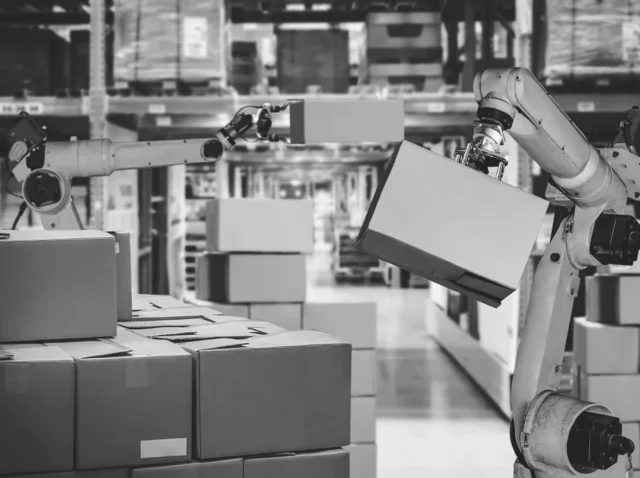
A cobot equipped with a gripper system picks boxed products from the conveyor, places them onto pallets in a precise configuration, and even wraps the load for shipping.
The Challenge:
Keeping track of inventory levels in real-time can be challenging, especially in large warehouses where human error can lead to miscounts and stockouts.
How Cobots Solve It:
✔ Real-Time Data Collection: Cobots use RFID and vision systems to monitor inventory levels and location, updating data automatically.
✔ Stock Replenishment: Cobots assist in restocking shelves based on inventory data, ensuring optimal stock levels.
✔ Error Reduction: Automated inventory checks minimize discrepancies and stock inaccuracies.
Implementation Example:
A cobot with RFID sensors scans shelves and updates inventory systems in real-time, alerting managers when stock levels are low and automatically restocking items.
The Challenge:
The final step of the delivery process often requires precise handling of packages and last-minute route adjustments, leading to delays or mistakes.
How Cobots Solve It:
✔ Route Optimization: Cobots integrated with AI optimize delivery routes and schedules for efficiency.
✔ Package Handling: Cobots ensure that items are handled safely and securely until they reach the final delivery stage.
✔ Speed & Reliability: Cobots can operate 24/7, increasing delivery throughput while reducing human error.
Implementation Example:
A cobot equipped with sensors autonomously navigates through a warehouse, retrieves the last-mile delivery package, and prepares it for dispatch, ensuring timely deliveries.
The Challenge:
Manual sorting and routing of packages can create bottlenecks, especially during peak periods, causing delays and errors.
How Cobots Solve It:
✔ Dynamic Routing: Cobots adapt to traffic and workflow changes within distribution centers, optimizing sorting times.
✔ High-Speed Sorting: Cobots can sort packages based on destination and priority, ensuring efficient routing for outbound shipments.
✔ Integrated with AGVs: Cobots work seamlessly with Automated Guided Vehicles (AGVs) for full-cycle automation.
Implementation Example:
A cobot moves packages from the sorting area to AGVs or staging areas, using AI to choose the optimal route based on real-time traffic and workflow conditions.
The Challenge:
Manual labeling of packages can lead to mistakes in addresses, shipment details, and tracking numbers, affecting delivery efficiency and customer satisfaction.
How Cobots Solve It:
✔ Automated Labeling: Cobots print and apply shipping labels with precision, reducing the risk of human error.
✔ Real-Time Documentation: Cobots integrate with your warehouse management system (WMS) to update documentation instantly.
✔ Higher Accuracy: Automated documentation and labeling ensure correct order information is linked to the right package.
Implementation Example:
A cobot applies the correct shipping label to each package while simultaneously updating the WMS with the order’s status and tracking number.



product storyHow a Leading Distributor Streamlined Their Operations
A large logistics company was facing slowdowns and errors in their sorting process, which was affecting delivery speed and increasing costs. Here’s how collaborative robots helped:
⚠ Sorting and packaging errors were causing delays and inaccurate shipments.
⚠ Labor shortages were putting extra strain on workers, leading to burnout.
⚠ Manual handling of heavy items was slow and prone to accidents.
After integrating cobots, the company experienced:
✔ 25% faster sorting times, with automated routing and packaging.
✔ 35% fewer errors, thanks to precision automation in sorting and labeling.
✔ Improved worker satisfaction, as employees were freed from repetitive tasks to focus on value-added activities.
The result? A significant boost in operational efficiency, reduced costs, and a safer working environment, all thanks to collaborative robots.

featured resoursesDive Deeper into Cobots for Logistics & Distribution


FAQsEverything You Need to Know About Collaborative Robots
What makes cobots different from traditional robots?
Cobots are designed to work safely alongside human operators without requiring barriers, making them more flexible for integration into existing systems.
How long does it take to integrate cobots?
Cobots are plug-and-play, meaning they can be quickly set up with minimal downtime, ensuring a smooth integration process.
Can cobots be customized for my logistics needs?
Absolutely. We collaborate with you to design cobot solutions that fit your specific operations, from sorting and packing to last-mile delivery.
Will cobots replace human workers?
No. Cobots are here to enhance your workforce, handling repetitive tasks while allowing human employees to focus on higher-value activities.
Do cobots require ongoing maintenance?
Cobots are designed for minimal maintenance and long-term reliability. Our support team ensures your systems stay operational without interruption.
Collaborative Robots
in Logistics and Distribution
Ready to Transform Your Logistics & Distribution Operations?
Let’s make your logistics smarter, faster, and more efficient with collaborative robots.