

industry use cases - consumer goodsRobotic Palletization & Repalletization in Consumer Goods
Let’s face it—running a high-volume consumer goods operation isn’t getting any easier. Supply chain disruptions, rising labour costs, and increasing SKU complexity are making it increasingly challenging to meet demand. With customers expecting faster delivery times and flawless execution, there is no room for inefficiency.
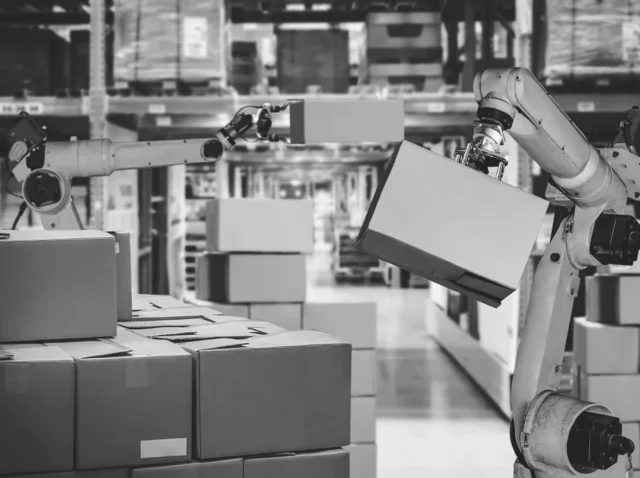
That’s where robotic palletization and re-palletization come in. These automated systems don’t just move boxes; they transform the way your warehouse operates. By eliminating bottlenecks, reducing manual labour, and ensuring consistent stacking, robots help you keep pace with demand while improving workplace safety.
The best part? You don’t need a complete warehouse overhaul. Robotic palletizing solutions integrate seamlessly into your existing operations, handling everything from mixed-load palletizing to retailer-specific re-palletization. Let’s explore how automation is changing the game for consumer goods companies.
The Challenge:
Consumer goods manufacturers operate at high speed, but manual palletizing creates bottlenecks, inconsistencies, and workplace injuries due to repetitive lifting.
How Robotics Solves It:
✔ Consistent Stacking: Ensures stability and maximizes pallet density, reducing damage during transport.
✔ Speed & Throughput: Operates continuously without breaks, keeping pace with high-speed production lines.
✔ Improved Workplace Safety: Eliminates ergonomic strain and reduces workplace injuries.
Implementation Example:
A robotic palletizer automatically stacks cases of bottled beverages at the end of a high-speed production line, maintaining a steady output of 60 cases per minute.
The Challenge:
Retailers require mixed-load pallets with diverse SKUs, creating a logistical challenge for warehouses relying on manual sorting and stacking.
How Robotics Solves It:
✔ Intelligent Sorting: AI-driven palletizers group and stack different products according to retailer specifications.
✔ Flexible Handling: Adapts to varying box sizes, weights, and stacking patterns.
✔ Faster Order Fulfilment: Eliminates slow manual sorting, reducing lead times.
Implementation Example:
A robotic system sorts and stacks personal care items into retailer-specific pallets, meeting customized order requirements for each distribution centre.
The Challenge:
Large retailers often require custom pallet configurations, forcing warehouses to manually break down and restack pallets, increasing labour costs and processing time.
How Robotics Solves It:
✔ Automated Restacking: Robots deconstruct and reconstruct pallets to meet retailer compliance requirements.
✔ Eliminates Manual Labor: Reduces the need for warehouse workers to reconfigure pallets by hand.
✔ Compliance & Accuracy: Ensures that shipments meet specific store layout and logistics needs.
Implementation Example:
A robotic de-palletizer breaks down bulk shipments of packaged foods and re-palletizes them into store-ready mixed loads for major grocery chains.
The Challenge:
Warehouses handling cross-docking or direct-to-store shipments must frequently unload and sort mixed pallets, leading to inefficiencies and errors.
How Robotics Solves It:
✔ High-Speed Unloading: Robots quickly de-palletize mixed loads for efficient sorting.
✔ Error Reduction: AI vision systems ensure correct SKU placement in outbound shipments.
✔ Seamless Integration: Works with existing conveyor systems for smooth distribution.
Implementation Example:
An automated system de-palletizes cartons of consumer electronics from inbound shipments, sorting them by SKU before routing them to different store orders.
The Challenge:
Direct-to-consumer shipping requires customized packaging and pallet configurations, making traditional palletizing inefficient.
How Robotics Solves It:
✔ Custom Packing & Stacking: Robots adjust packing patterns dynamically for various order types.
✔ On-Demand Fulfilment: Handles fluctuating order volumes with ease.
✔ Seamless Integration: Works alongside existing automation like AMRs and conveyors.
Implementation Example:
A robotic system picks and packs snack products for e-commerce orders, stacking them efficiently onto pallets for last-mile delivery.
The Challenge:
Manual palletizing of heavy consumer goods (e.g., appliances, furniture) increases the risk of product damage and worker injuries.
How Robotics Solves It:
✔ Gentle Handling: Advanced gripping technology prevents product damage.
✔ Load Stability: Ensures secure stacking to avoid shifting during transport.
✔ Worker Safety: Reduces strain from lifting heavy or awkwardly shaped products.
Implementation Example:
A robotic palletizer handles boxed home appliances, using AI vision to place each item securely while preventing over-compression.
product storyHow a Consumer Goods Distributor Increased Throughput by 40%
A leading CPG distributor faced challenges with manual re-palletization for big-box retailers, leading to labour shortages and high processing times. Here’s how automation transformed their operations:
⚠ Manual re-palletization was slow and costly.
⚠ Frequent stacking errors caused retailer chargebacks.
⚠ Worker fatigue led to increased turnover.
By implementing robotic re-palletizing stations, they saw immediate improvements:
✔ 40% faster order processing with fully automated retailer-specific palletization.
✔ Zero stacking errors, eliminating costly compliance penalties.
✔ Reduced labour dependency, improving workforce efficiency.
The result? Faster, more accurate deliveries with lower operational costs.

featured resoursesLearn More About Robotic Palletizing & Repalletizing


FAQsEverything You Need to Know About Robotic Palletizing
How does robotic palletizing integrate with my existing operations?
Our systems are designed for plug-and-play integration with minimal disruption, working alongside conveyors, AMRs, and existing warehouse automation.
Can robots handle different box sizes and stacking patterns?
Yes. Our AI-driven systems dynamically adjust stacking configurations to accommodate different SKUs, weights, and packaging types.
How much floor space do I need for robotic palletizing?
Our solutions are compact and modular, fitting within existing warehouse layouts without requiring major redesigns.
Will robots replace my workforce?
No. Robotic palletizing is designed to augment your team, handling repetitive tasks so workers can focus on higher-value activities.
How long does it take to implement a robotic palletizing system?
Most deployments are up and running within weeks, with minimal downtime during installation.
Robotic Cell Palletization & Repalletization in Consumer Goods
Ready to Transform Your Warehouse Operations?
Let’s make your logistics faster, safer, and more efficient with robotic palletization.