
industry use cases - food and beverageRobotic Palletization & Repalletization in Food and Beverage
The food and beverage industry is under constant pressure to meet rising consumer demand while ensuring the highest quality and safety standards. As a production or operations manager, you are no stranger to the challenges of labor shortages, fluctuating demand, and maintaining hygiene standards. That’s where robotic palletization and repalletization come in. These systems offer a flexible and reliable way to streamline your production process while maintaining efficiency and safety.
Let’s explore how robotic cells are making a real difference in the food and beverage industry.
The Challenge:
Handling large quantities of packaged food items manually can be slow and labour-intensive. Ensuring that each item is stacked correctly to optimize warehouse space while avoiding damage is a time-consuming task. Traditional methods often lead to inconsistent stacking, inefficiencies, and safety concerns.
How Robotics Solves It:
✔ Speed & Efficiency: Robots automate the palletizing process, significantly increasing throughput while maintaining a consistent stacking pattern.
✔ Space Optimization: Robotic systems can handle more products with precise alignment, maximizing warehouse storage capacity.
✔ Reduced Human Error: Robots ensure each item is placed in the optimal position, reducing damage and improving overall pallet stability.
Implementation Example:
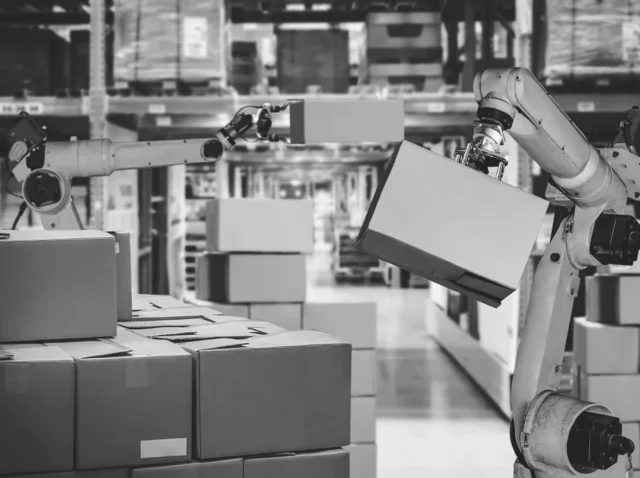
A robotic arm with advanced vision systems is used to pick up canned goods and place them onto pallets in an optimized pattern, minimizing wasted space and ensuring safe transport.
The Challenge:
Food products come in a wide range of packaging formats—bags, bottles, boxes, and more. Managing these variations manually is complex and prone to errors, especially when switching between packaging types in high-demand periods.
How Robotics Solves It:
✔ Adaptable Grippers: Robotic arms are equipped with specialized grippers that can handle various packaging formats, from fragile bottles to heavy boxes.
✔ Flexible Software: Advanced software allows the robot to quickly adapt to new packaging formats, minimizing downtime during production line changes.
✔ Reduced Changeover Time: Robots can switch between tasks with minimal interruption, improving overall production flow.
Implementation Example:
A robotic cell equipped with vision recognition and adaptive grippers handles a mix of bottled beverages and frozen food, ensuring each is placed in the correct orientation for palletization.
The Challenge:
Hygiene is critical in food and beverage production, especially when dealing with perishable goods. Maintaining sanitary conditions during palletization and repalletization can be difficult with traditional manual processes that involve human contact.
How Robotics Solves It:
✔ Easy to Clean Design: Robotic systems are designed for easy sanitization, with smooth surfaces and minimal crevices where bacteria can accumulate.
✔ Consistent Hygiene Practices: Robots can follow strict sanitation protocols without lapses, ensuring that hygiene standards are consistently met.
✔ Hygienic Operation: Automation reduces human intervention, lowering the risk of contamination during packaging.
Implementation Example:
A robotic palletizer working in a cleanroom environment is sanitized after every shift, ensuring a contamination-free production process for packaged ready-to-eat meals.
The Challenge:
Fluctuating demand during holidays or special promotions can create strain on production lines, leading to backlogs or inefficiencies. The need for rapid adjustment in production schedules adds complexity to an already demanding process.
How Robotics Solves It:
✔ Scalability: Robotic systems can handle increased demand without needing to hire additional labor, helping companies scale production quickly.
✔ Consistent Speed: During peak times, robots maintain high-speed operations without fatigue or delays, ensuring that demand spikes are met with precision.
✔ Flexibility in Shifts: Robots can seamlessly switch between different packaging types or shift from low to high production without significant downtime.
Implementation Example:
During a holiday rush, a robotic system adjusts its speed and operation to handle the increased volume of bottled beverages, ensuring the production line continues smoothly without bottlenecks.
productsSolutions Tailored for Food and Beverage Manufacturing


product storyHow One Food Manufacturer Boosted Efficiency by 25%
Imagine this: A major food manufacturer was struggling to keep up with seasonal demand. Manual palletizing and repalletization were taking up too much time and leaving room for error. Here’s how automation transformed their operations:
⚠ Manual processes were leading to slowdowns and inconsistent stacking.
⚠ Hygiene concerns were increasing operational risks.
⚠ High demand fluctuations during the holiday season were putting immense pressure on staff.
After integrating robotic palletization systems, the company saw:
✔ 25% increase in throughput with robots handling seasonal demand surges effortlessly.
✔ 50% reduction in palletization errors, ensuring products were properly stacked and ready for shipping.
✔ Improved hygiene with robots designed for easy cleaning and zero human contact in critical areas.
In the end, the manufacturer was able to improve both efficiency and safety, ensuring smooth operations year-round.

featured resoursesDive Deeper into Robotic Palletization & Repalletization

FAQsEverything You Need to Know About Robotic Palletization & Repalletization
How do robots handle different packaging formats?
Robots equipped with specialized grippers and vision systems can adapt to a variety of packaging types, from bottles to frozen food boxes. The software ensures a smooth transition between different formats.
Can robotic palletizers be used in refrigerated or extreme temperature environments?
Yes, robotic systems are designed to function in a wide range of temperatures, including cold storage environments.
How long does it take to integrate robotic systems into my production line?
Robots are typically quick to integrate with existing systems, with minimal downtime required for setup.
Will robots replace human workers?
Robots are designed to work alongside human operators, handling repetitive and labor-intensive tasks, which allows workers to focus on higher-value tasks.
What about ongoing maintenance?
Robots require minimal maintenance. Our team provides full support to ensure that your robotic systems run smoothly over the long term.
Robotic Palletization & Repalletization in Food and Beverage
Ready to Transform Your Food Production Line?
Let’s enhance your production line’s efficiency, speed, and safety with robotic automation.