
Most warehouses were designed with one primary focus in mind: efficiency in moving pallets and products from point A to point B. And while this might be sufficient for static operations, it doesn’t hold up in today’s fast-paced, data-driven business environment.
- When your business begins to scale, challenges arise
- Inventory complexity increases, orders diversify and grow in volume, and the demand for speed becomes relentless
- Suddenly, the once-effective layout becomes a bottleneck. Blind spots emerge.
- Teams are forced into reactive decision-making.
- The chaos originates not in the physical warehouse but in outdated thinking.
To thrive in this evolving landscape, warehouse directors must reframe how they approach design. A modern warehouse is no longer just racks and forklifts; it is a dynamic, real-time data engine. And the leaders who succeed are those who design logic-first systems powered by edge devices and intelligent workflows.
At Artsys, we’ve seen how this mindset shift—from physical-first to logic-first design—not only future-proofs operations but also boosts efficiency, reduces costs, and unlocks growth. Here’s how to start rethinking your warehouse, using principles borrowed from software architecture.
Traditional Mindset vs. Modern Challenges
Most warehouses still rely on layouts and workflows optimised solely for physical movement. Forklifts, static shelving, and fixed zones dominate these spaces. And while optimising physical space is essential, it’s not enough when you’re ignoring the flow of information.
Here’s what happens with a physical-first mindset:
- Disconnected Systems: Essential systems don’t talk to each other, creating silos.
- Constant Troubleshooting: Warehouse Management System (WMS) headaches sap energy and time.
- Reactive Operations: Instead of preventing problems, teams respond to crises because they lack real-time insight.
The result? Bottlenecks and inefficiencies that grow exponentially as the business scales.
The reality: A modern warehouse is powered by data flows. Without designing for real-time insights and intelligent automation, even the most efficient physical layout will falter under growing demand.
Why Logic-First Thinking Is the Future
At Artsys, our edge automation philosophy is rooted in a simple truth: smart warehouse design doesn’t start with technology; it starts with logic.
Think of software systems. Every action within the system is intentional. Workflows are carefully designed so that each input produces the best possible outcome. The same principles need to be applied to warehouse operations.
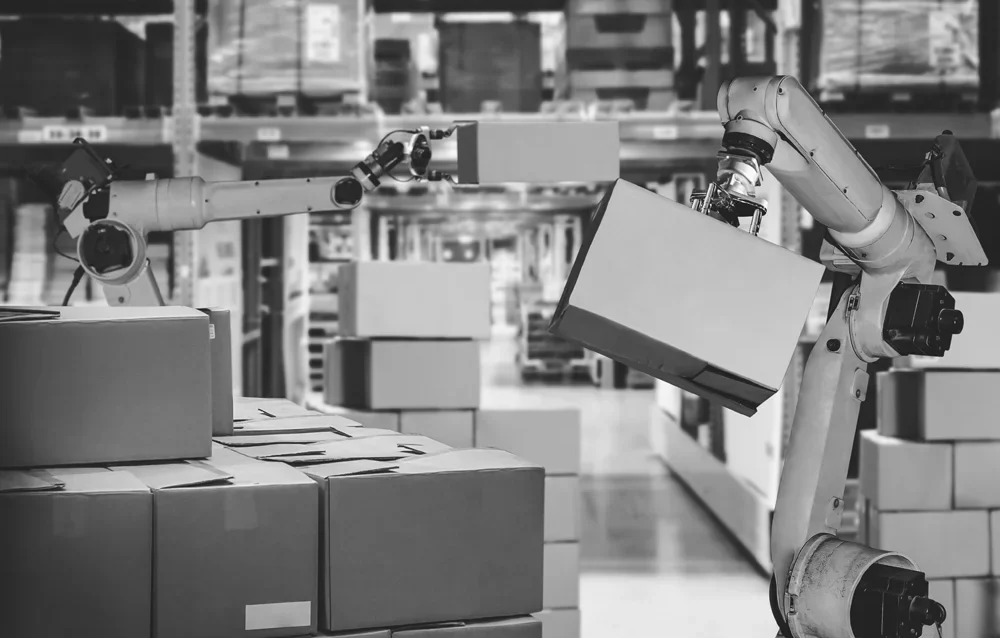
When you design with logic-first thinking, the warehouse becomes a real-time system. Data flows smoothly from one node to another, enabling intelligent decisions at every level of the operation. Robots, RFID scanners, autonomous vehicles, and edge-powered devices communicate seamlessly to adapt to changing conditions moment by moment.
Here’s how to start making the shift.
Rethink Your Warehouse Design Like a Software System
Step 1: Design for Data Visibility
Your warehouse doesn’t just move products; it moves information. Without clear insights into inventory, locations, and workflows, you’re driving blind. Data visibility is the foundation of smart warehouse operations.
Where to start:
Edge Capture Points..Deploy RFID scanners, vision systems, and sensors at crucial junctures like inbound, picking, and outbound zones. These devices provide real-time updates on inventory location and movement, allowing you to spot potential disruptions before they escalate.
Synchronised Systems. Integrate your existing WMS with edge automation tools to eliminate manual data entry and bridge silos. Even legacy systems can benefit from these upgrades without needing a complete overhaul.
Misconception: You need a brand-new WMS to gain visibility.
Reality: Edge-powered tools work with your existing systems to deliver insights in real-time.
Step 2: Automate Logic Flows
Moving products faster won’t solve all your problems. The next step is to optimise decision-making with automated logic flows.
Where to start:
Warehouse Execution System (WES). A WES works hand-in-hand with edge devices to trigger dynamic actions. For example, if one fulfilment zone becomes overloaded, the system can reroute tasks to more efficient zones in real time.
Edge Analytics. Process data directly on the warehouse floor to reduce latency and act immediately. By using IoT-enabled devices, decisions such as rerouting or replenishing stock happen faster than any human can execute them.
Misconception: Only big, cloud-based systems can manage flow optimisation.
Reality: Edge logic acts faster, without relying on constant cloud connectivity.
Step 3: Reframe Layout as a Data Stream
Forget thinking solely about physical paths and footprints. Instead, design your layout to prioritise data flow. A streamlined flow of information enhances the physical movement of goods.
Where to start:
Zone Optimisation. Group zones based on logical workflows instead of traditional categories like product type. For example, allocate zones where scanning or tracking is seamless, reducing unnecessary movement.
Flow-First Layout. Integrate robotic cells and dynamic zones into the design for continuous movement. Traditional bottlenecks (like manual product handoffs) can be replaced with efficient, data-driven processes.
Misconception: Optimising forklift paths is the ultimate goal.
Reality: The slowest part of your warehouse isn’t your forklifts; it’s manual decision-making.
Key Takeaway: The Future Warehouse Is Software-Defined
Here’s the hard truth. The problem isn’t your legacy systems; it’s the mindset behind them.
To future-proof operations, warehouses need:
- Real-time visibility
- Connected workflows
- Edge-powered automation
By shifting your thinking from forklifts and aisles to logic and flow, you can reduce costs, remove bottlenecks, and equip your warehouse to scale at speed.
book a call with an artsys edge specialistWant to bring edge automation to your team?
Let’s talk about how you can streamline operations, reduce errors, and empower your staff with real-time solutions that work right where care happens.