
The night shift tells you the true: why automation “works” and the factory is still unstable
In many Romanian factories, production flows are not stabilized by processes, but by people. Even automated factories with state-of-the-art robots have managed to increase installed capacity, yet the production line remains unstable.
This often happens because discussions between integrators and production decision-makers almost always start from speed, precision, payload, the level of technological intelligence, or the robot’s position along the production line.
Project success is defined by FAT/SAT, with the focus placed on delivery. As a result, risk is concentrated in the implementation phase.
These criteria are not wrong — they are incomplete. On the shop floor, in real production conditions, the true risks are not related to speed (for example, a line running 5% slower), but to:
- unplanned stoppages that block the entire line flow;
- dependence on one or two key people without whom “nothing moves forward”;
- performance degradation from one shift to another;
- loss of control over cost per part, which starts to vary depending on who is present and their level of fatigue.
We have all been in the morning meeting and experienced these situations. On one hand, reports show an acceptable OEE and a list of “classic” downtimes: a new SKU, different packaging sizes, new operators, shifts with missing staff, consumables running out, a part slightly out of spec, a box with different tolerances, a pallet with variable quality.
At the end of the production line, losing 15–30 seconds does not seem significant. But when this happens aprox 200–300 times per shift, multiplied by 20 seconds, it adds up to roughly 100 minutes per shift. That means about 1.5 hours of lost capacity without any “incident,” without a major downtime, and without triggering any alarms.
The real loss does not lie only in reported downtime; it lies in micro-stoppages and distributed idle times that quietly break the factory’s daily and weekly production rhythm.
From “automation as a technical project” to “automation as infrastructure”
In factories that operate stably over the long term, automation is evaluated through a very different set of questions — more uncomfortable, but far more relevant.
How does the system behave when a minor deviation occurs, not a major failure? What happens when the experienced operator is on leave and someone new takes over? How does the automation react when a SKU appears that is “almost the same,” but not identical? And how does the entire system behave at 2:00 a.m., on the third shift, when there is no one available to improvise?
(You can access our full list of questions for different collaborative robot automation scenarios here.)
Automation designed as infrastructure directly addresses these sensitive points.
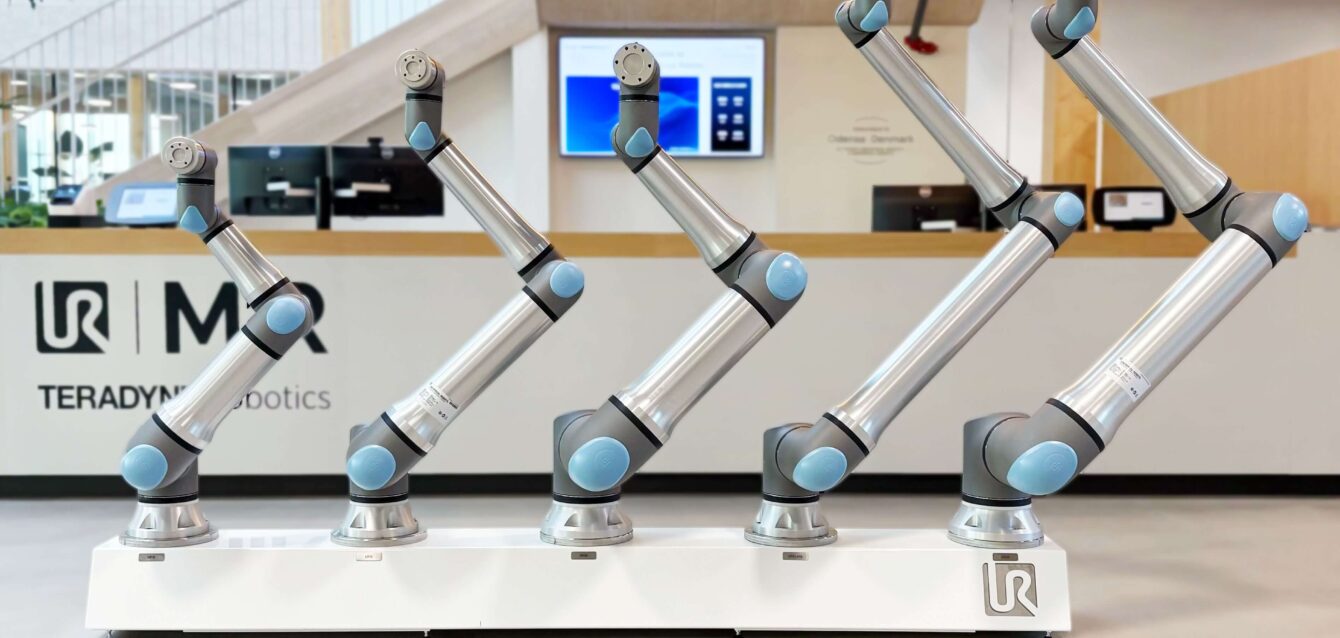
The Universal Robots Platform — A Partnership for Production Line Stability
Automation conceived as infrastructure requires a platform that enables standardization, local control, and predictable behavior over time.
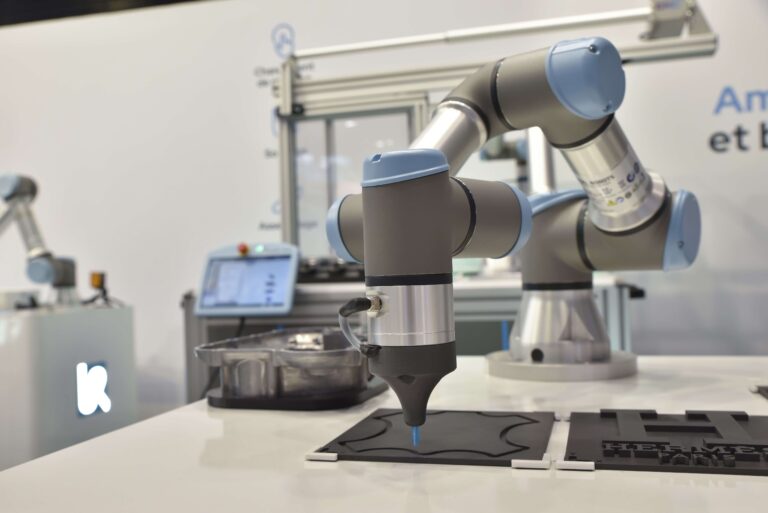
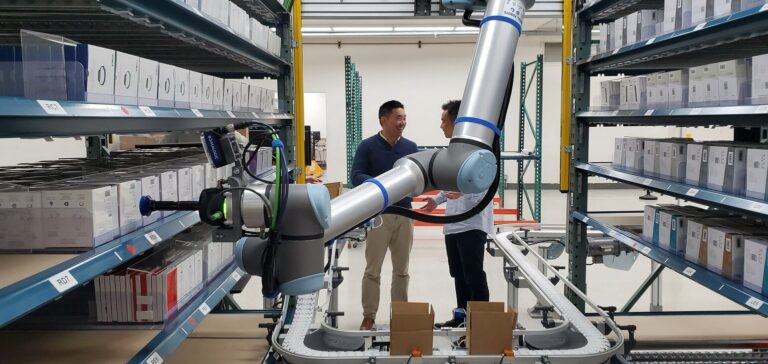
Universal Robots has become a global standard precisely because it accepts the reality of existing factories. The platform developed by Universal Robots is designed for already crowded spaces, for production lines that cannot be rebuilt from scratch, for interaction with operators, and for incremental implementations.
The platform allows us to build standardized yet adaptable applications without locking the factory into a rigid, proprietary architecture. It can support two or three shifts, fluctuating volumes, and a high product mix.
Collaborative robots respond with repeatable motions, react immediately to events, operate with clear and understandable logic, and can run unsupervised. At the same time, factory personnel — not only integrators or highly specialized programmers — can perform basic programming, adjustments, and diagnostics.
The Universal Robots Platform — A Partnership for Production Line Stability
Automation conceived as infrastructure requires a platform that enables standardization, local control, and predictable behavior over time.
Universal Robots has become a global standard precisely because it accepts the reality of existing factories. The platform developed by Universal Robots is designed for already crowded spaces, for production lines that cannot be rebuilt from scratch, for interaction with operators, and for incremental implementations.
The platform allows us to build standardized yet adaptable applications without locking the factory into a rigid, proprietary architecture. It can support two or three shifts, fluctuating volumes, and a high product mix.
Collaborative robots respond with repeatable motions, react immediately to events, operate with clear and understandable logic, and can run unsupervised. At the same time, factory personnel — not only integrators or highly specialized programmers — can perform basic programming, adjustments, and diagnostics.
Five Applications Where Universal Robots Collaborative Robots Stabilize Production Lines
1) Pick & Place for Consistent Production Lines and Predictable Cost per Part
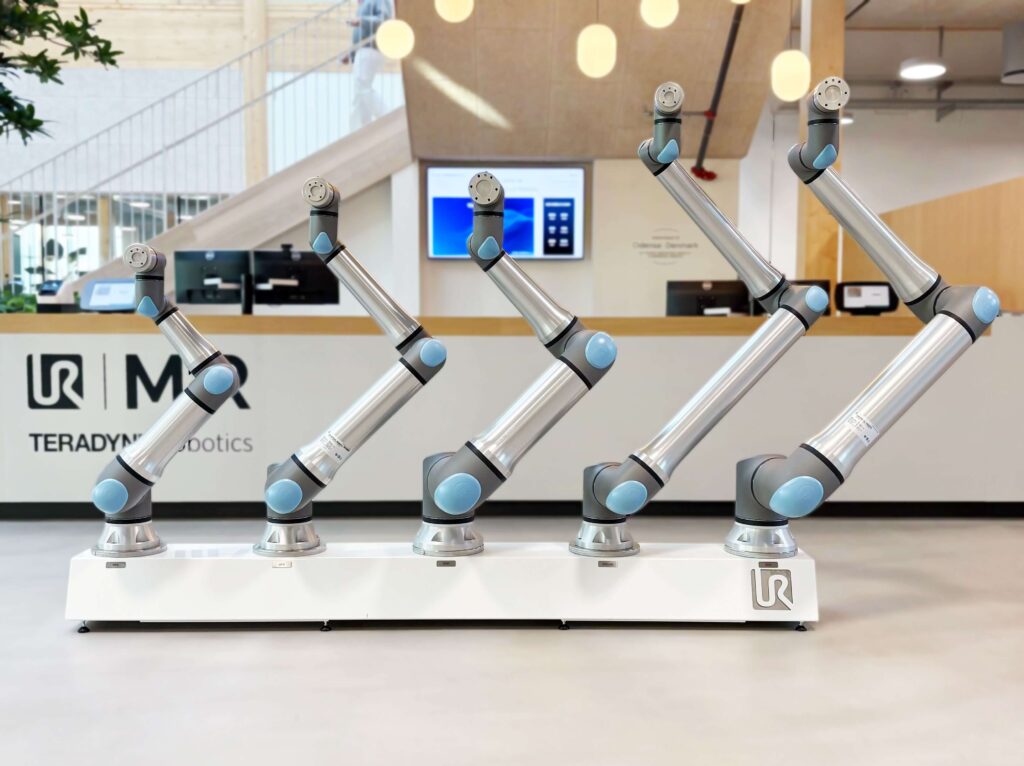
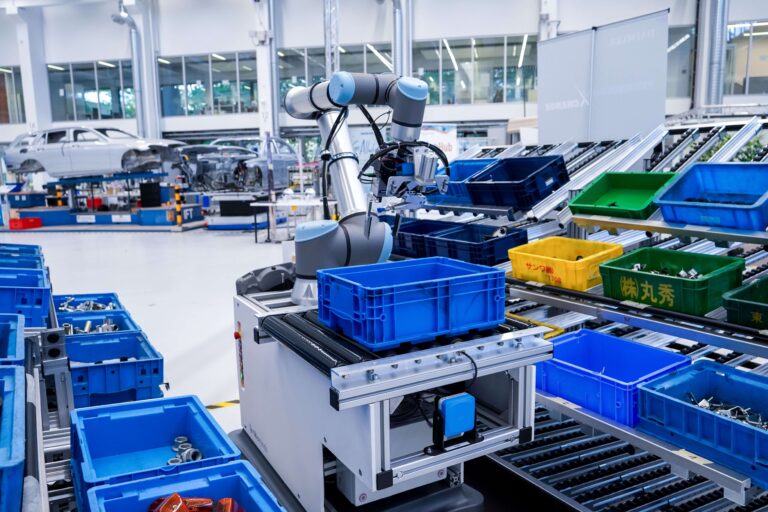
Three Universal Robots collaborative robots simplify life for production managers: UR3e, UR7e, and UR12e. Natively integrated with 2D and 3D vision systems — either eye-in-hand or with fixed cameras mounted on the line — they stabilize and add flexibility to production flows.
In practical terms, small variations no longer stop the line for adjustments, no longer require manual intervention, and no longer propagate delays upstream.
The robot no longer moves to a fixed “X,Y” position assuming the part is there. Instead, it verifies conditions: whether the part is present, whether the orientation is acceptable, and whether the grip is valid. If any condition is not met, the cycle adapts — a retry is performed, the part is rejected, or the cycle is skipped — without blocking the line.
As a result, unreported micro-stoppages disappear, operators no longer align parts “by eye,” upstream equipment no longer waits, and production no longer slows down preventively out of fear that pick & place will become a bottleneck.
Collaborative Robots for Pick and Place Applications
| UR Robot | Max Payload | Reach (mm) | Repeatability | Best Fit Applications | Why It Is Chosen in Practice |
| UR3e | 3 kg | 500 | ±0.03 mm | High-frequency pick & place, small and fine parts, electronics | Very high precision, small footprint, fast cycles; ideal for tight spaces and constant rhythm |
| UR7e | 5 kg | 850 | ±0.03 mm | General pick & place, multiple SKUs, 2D/3D vision integration, light bin picking | Most versatile model; handles variation well and supports easily replicated applications |
| UR12e | 12.5 kg | 1300 | ±0.05 mm | Large parts, boxes, trays, end-of-line pick & place, depalletizing | Long reach and sufficient payload for applications where human fatigue becomes a limiting factor |
Packaging (Primary / Secondary Packaging) — Stabilizing the Area with the Highest Variability
In packaging, the real problem is instability caused by frequent changes: multiple SKUs, different formats, promotions, and “almost identical” packaging variants.
The UR7e, UR12e, and UR16e are designed to provide a practical balance between speed, payload, and reach—without requiring a full line rebuild. They are fast enough for packaging operations, but more importantly, flexible enough to handle multiple SKUs through recipes rather than mechanical adjustments.
Tasks such as placing products into trays, feeding flow wrappers, closing boxes, or handling blisters and bottles become repeatable, consistent operations, regardless of the shift. This significantly reduces “small but frequent” rejects and eliminates the slowdowns that typically occur during changeovers and transitions.
Collaborative robots for packaging applications
| UR Robot | Max Payload | Reach | Best Fit Applications | Why It’s Chosen in Packaging |
| UR7e | 5 kg | 850 mm | Light product packaging, frequent SKU changes, flow-wrapper feeding | Highly flexible, fast short-cycle times, ideal for frequent changeovers |
| UR12e | 12.5 kg | 1300 mm | Boxes, trays, bulky products, secondary packaging | Long reach + sufficient payload for most real-world applications |
| UR16e | 16 kg | 900 mm | Heavier packaging, large grippers, higher mechanical stability | Chosen when weight matters more than speed |
End-to-End Palletizing with Universal Robots Collaborative Robots
UR12e — Light Palletizing, Basic End-of-Line Stabilization
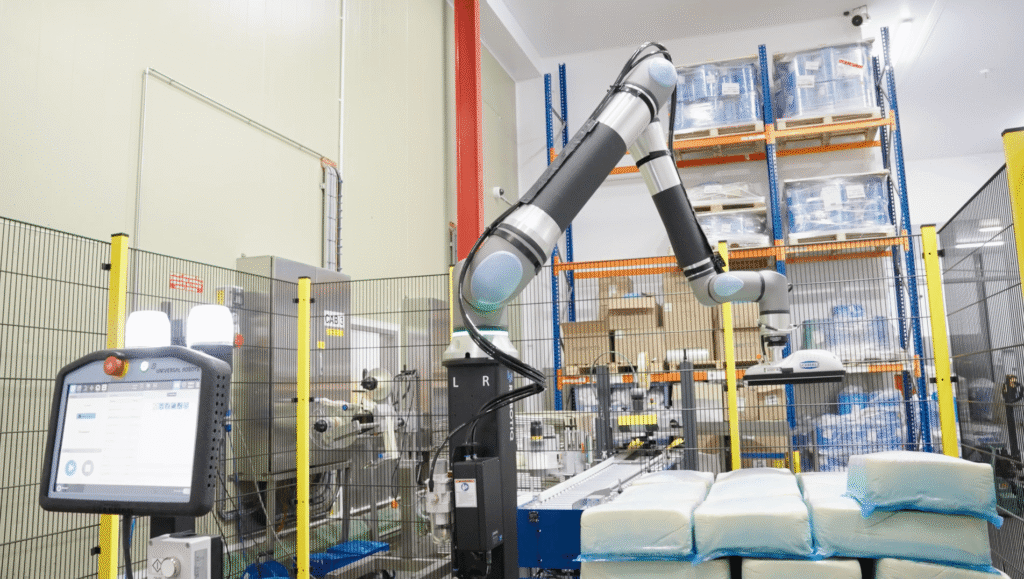
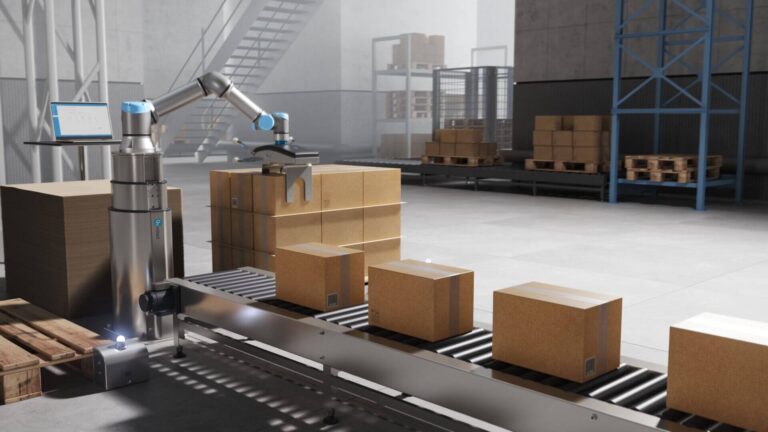
The UR12e is used for palletizing standard boxes, typically up to 12 kg, in applications where stack height is moderate and pallet patterns are not extreme. The robot picks boxes directly from the conveyor, places them according to a defined pattern, and handles full or partial pallets without manual intervention. It is widely used in FMCG, secondary packaging, and lines where the goal is to eliminate physical strain and maintain a consistent rhythm across all shifts.
UR16e — Medium Palletizing, Increased Mechanical Stability
The UR16e is selected when the actual weight of the box or the gripper starts to matter. It is used for heavier boxes, compact multipacks, or situations where the pick position is less favorable (lateral reach, variable heights). In practice, the UR16e takes over palletizing when the UR10e is operating near its stability or continuous-load limits across multiple shifts.
UR20 — Industrial Palletizing, High Stacks
The UR20 is explicitly designed for serious industrial palletizing. It is used for high stacks, layouts where the pallet is positioned farther from the conveyor, and applications requiring long reach without compromising stability. The UR20 palletizes heavy boxes across multiple layers, maintains stable trajectories, and supports continuous operation—without moving into the realm of traditional industrial robots with large safety fences and rigid layouts.
UR30 — Heavy Palletizing, Multipacks and Bags
The UR30 is used for the most demanding collaborative palletizing applications: heavy multipacks, bags, bulky packages, or combinations of heavy boxes and large grippers. It is chosen when the total handled weight clearly exceeds the “classic cobot” range, but flexibility, compact integration, and controlled collaboration with operators are still required. In factories, the UR30 directly replaces manual palletizing across 2–3 shifts.
Collaborative robots for palletization applications
| UR Robot | What It Palletizes | Typical Box Weight | Stack Height | When to Choose |
| UR12e | Standard boxes, secondary packaging | up to ~12 kg | low–medium | When stable palletizing is needed without oversizing |
| UR16e | Heavier boxes, compact multipacks | ~15–18 kg | medium | When the UR10e is at its stability limit |
| UR20 | Heavy boxes, high stacks | ~20 kg | high | Continuous industrial palletizing |
| UR30 | Heavy multipacks, bags, bulky packages | up to ~30 kg | medium–high | Heavy-duty palletizing, 24/7 operation |
Machine Tending with Universal Robots Collaborative Robots
In machine tending applications, the collaborative robot does not “automate the machine.”
It eliminates idle time between cycles and removes dependence on the continuous presence of an operator.
Concretely, the cobot waits for the machine’s end-of-cycle signal (CNC, press, injection molding), opens the door or interface, removes the finished part, places it in a defined location (tray, conveyor, washing machine), then picks up the raw part and loads it back into the machine—using the same position and the same sequence every single time.
Synchronization is handled simply via I/O, without complex architectures, and the robot can operate unattended for long periods, including outside normal working hours.
UR7e — Machine Tending Where Space and Access Are the Real Constraints
UR7e delivers value in machine tending through its compact size, high repeatability, and fast integration next to compact machines.
It enables automation of small CNC machines and stations where access is tight, the door opening is limited, and operators lose time simply loading and unloading light parts. The real advantage is not payload, but the ability to mount the robot very close to the machine without major layout changes, completely eliminating idle time between cycles.
In practice, UR7e allows one operator to supervise 2–3 machines while maintaining constant cycles regardless of shift.
UR12e — The De Facto Standard for Stable Machine Tending
UR12e covers the majority of real-world machine tending applications without compromise.
What it brings is the combination of sufficient reach for large CNC doors, usable payload, and mechanical stability over long cycles. In production, UR10e is not chosen for speed, but for its ability to maintain identical behavior every cycle: loading, positioning, closing, starting—without variation between shifts.
UR12e turns machine tending from an operator-dependent activity into a plannable process, enabling unattended operation during breaks and late shifts.
UR16e — Mechanical Stability for Heavy Parts and Difficult Access
UR16e brings what demanding machine tending applications were missing: real stability margin.
It is selected when the part, gripper, or loading position pushes smaller robots to their limits. UR16e allows handling of heavy parts without vibration, loading machines where the access point is farther away, and maintaining stable cycles in presses or injection molding machines.
The key difference is not just higher payload, but the ability to sustain these applications across 2–3 shifts without degradation—making UR16e suitable for machine tending as infrastructure, not as a borderline solution.
Integration of Collaborative Robots with 2D / 3D Vision Systems
Integrating a cobot with a vision system is not about AI or spectacular automation.
Vision systems remove the need for “perfect alignment” and replace it with controlled tolerance.
Without vision, the collaborative robot executes pre-programmed positions and assumes the part is correctly placed. With vision, the algorithm identifies the part, calculates its position and orientation, and sends this information to the robot to dynamically adjust the trajectory and gripper orientation.
When format, size, or color variations exist, the vision system recognizes multiple SKUs, distinguishes approximate dimensions, and confirms product presence or absence.
In intelligent pick & place, bin picking, and depalletizing applications, part positioning no longer matters: the robot identifies the accessible part and computes a single safe grip without colliding with others.
In quality control applications, the collaborative robot checks correct orientation, detects defects, validates labels, codes, or markings, and rejects non-conforming parts—directly on the production flow.
Collaborativi Robots for machine tending applications in manufacturing
| Machine Type / Real Situation | Recommended Robot | Why, Concretely |
| Small CNC, tight access, light parts | UR7e | Small footprint, fits close to the door, removes idle time without layout changes |
| Standard CNC, wide door, medium parts | UR12e | Sufficient reach + stability over long cycles; correct default in 70–80% of cases |
| Large CNC, deep table, distant loading point | UR16e | Reach + real payload without vibration at full extension |
| Mechanical presses (heavier parts) | UR16e | Stability margin, safe handling in demanding environments |
| Plastic injection molding machines | UR12e / UR16e | UR12e for medium parts; UR16e when molds are deep or parts are heavy |
| Parts washing machines | UR7e / UR12e | Constant rhythm, repeatable positioning, no human effort |
| One cell serving two CNC machines | UR12e | Reach and flexibility sufficient for multi-machine servicing |
| Application near payload limits | UR16e | Chosen for margin, not “it barely works” |