
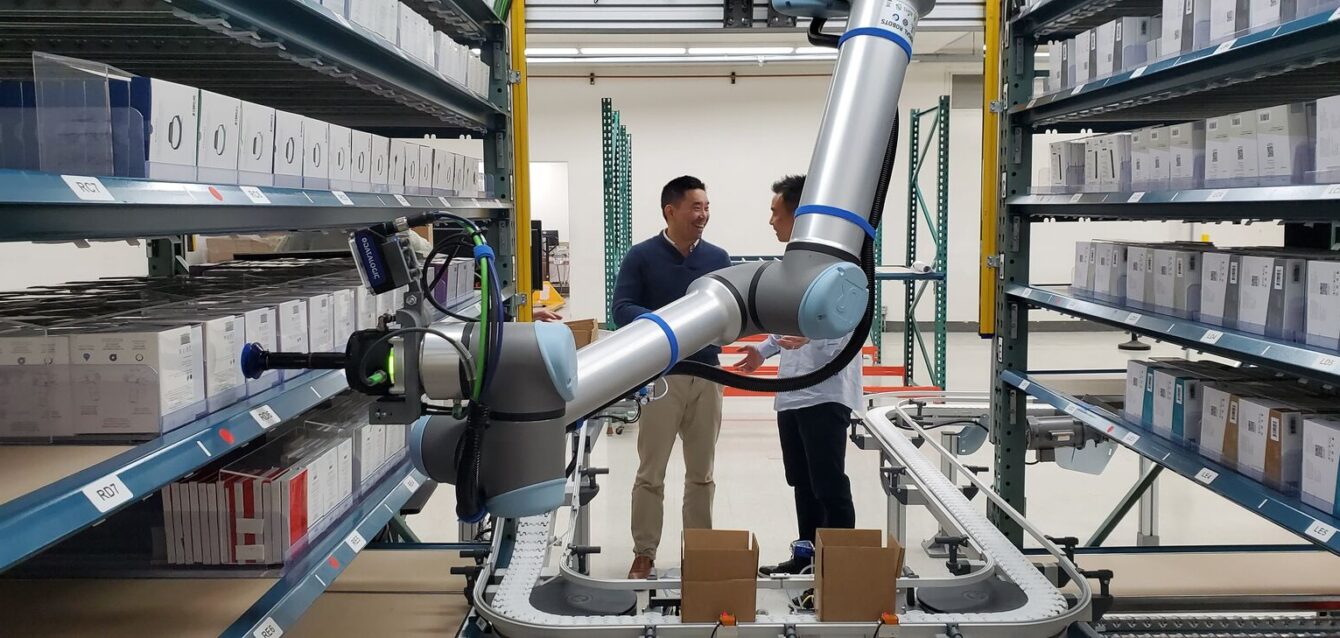
GUIDE Collaborative Robots: How to Handle Exceptions in Pick & Place, Packaging, Palletizing and Machine Tending Applications in Production
In a factory where staff turnover, SKU variations, and cost-per-piece pressures are constantly increasing, installing a robot does not automatically guarantee production line stability. Although collaborative robot automation projects may perform well during testing, real production go-live often tells a different story: micro-stoppages, idle time, and critical dependencies on key operators create fluctuations and interruptions that further amplify cost impact.
In partnership with Universal Robots, Artsys Automation shifts the conversation from technical specifications (speed, payload, reach) toward clearly defining exceptions, error scenarios, and real operational limits.
For applications such as pick & place, packaging, palletizing, and machine tending, the difference between an unstable line and a predictable one does not lie in the ideal cycle time, but in how the system responds to minor deviations.
The tables included in the article clearly illustrate what happens when these exceptions are not properly defined — and how to build standardized, repeatable behavior that is no longer dependent on “the best person on the production floor.”
What happens when Pick and Place with colaborative robots applications for manufacturing are not properly defined
| Production Exception | What Happens Without a Recipe | Correct Cobot Recipe | Impact if the Recipe Does NOT Exist |
| Missing part in the pick area | Robot waits or stops | Robot skips the cycle and continues | Irregular rhythm, micro-stoppages |
| Part positioned differently | Operator manually realigns | Robot adjusts trajectory using the vision system | Constant slowdowns |
| Incorrect part orientation | Operator approximates | Robot checks orientation and rejects the part | Repetitive downstream errors |
| Two parts stuck together / overlapping | Blockage or misgrip | Robot detects and refuses the pick | Unclear stops, operator stress |
| Misgrip (incomplete grip) | Robot stops | Automatic retry / part rejection | Frequent manual restarts |
| Part outside tolerance | Passed through “as is” | Robot rejects the part | Quality issues |
| Small dimensional variation | Manual adjustments | Tolerances defined in the recipe | Unstable line behavior |
| SKU change | Reprogramming / improvisation | SKU recipe selection | Long setup times |
| Operator intervention | Entire line stops | Robot enters safe mode and resumes | Difficult restarts |
| Restart after stop | Requires a specialist | Robot resumes from the last valid step | Dependence on key individuals |
What happens when packaging with collaborative robots applications for manufacturing are not properly defined
| Production Exception | What Happens Without a Recipe | Correct Cobot Recipe | Impact if the Recipe Does NOT Exist |
| Missing product at insertion | Empty package continues downstream | Robot skips the cycle / flags the event | Scrap, customer complaints |
| Product positioned incorrectly | Operator manually corrects | Robot adjusts position automatically | Packaging slowdown |
| Slightly deformed packaging | Operator decides “it’s OK” | Robot rejects the package | Transport and handling issues |
| SKU change | Mechanical adjustments required | Recipe change | Line stopped unnecessarily |
| Variable upstream rhythm | Operator slows down preventively | Robot waits in a controlled manner | Lost capacity |
| Flow-wrapper unavailable | Line blocked | Robot enters buffer mode | Chain stoppages |
| Missing box / tray | Operator searches manually | Robot enters wait mode | Operational stress |
| Missing / incorrect label | Detected late | Automatic visual verification | Costly rework |
| Wrong product in an SKU | Passes undetected | Robot validates visually | Quality issues |
| Operator intervention | Full reset required | Automatic cycle resume | Lost time |
| Shift change | Quality drops | Identical behavior maintained | Differences between shifts |
What happens when what happens when exceptions in end-to-end palletizing applications are not properly definedd
| Production Exception | What Manual Palletizing Does | Correct Cobot Recipe | Impact If the Recipe Does NOT Exist |
| Partial pallet (small order / SKU change) | Operator estimates manually | Robot completes the partial pallet, flags it as such, and automatically switches to a new pallet | End-of-line blockage, upstream stops |
| Full pallet not removed on time | Operator waits or moves it manually | Robot enters “wait buffer” mode, skips the cycle, or redirects to an alternative pallet | Repeated short stops, shift stress |
| Missing box on conveyor | Operator improvises | Robot detects absence and skips the cycle without alarm | Robot waits unnecessarily, throughput drops |
| Damaged / deformed box | Operator removes it manually | Robot rejects the box and sends it to reject | Unstable pallet, transport issues |
| Box weight out of tolerance | Rarely detected | Robot checks (via vision / sensor) and rejects | Overload, safety stops |
| Pallet pattern change | Manual adjustment, downtime | New recipe selected from HMI | Preventive line stoppage |
| New SKU | Improvised testing | SKU recipe selected, no mechanical adjustments | Major slowdown during changeover |
| Unstable stack detected | Manual correction | Robot corrects position or stops in a controlled manner | Pallet rejected by logistics |
| Operator enters palletizing area | Line fully stopped | Robot enters safe mode and automatically resumes cycle | Difficult restart, time loss |
| Forklift in the area | Operator stops palletizing | Robot slows down or waits according to rule | Sudden stops, upstream affected |
| Delayed empty pallet supply | Operator searches for pallet | Robot enters waiting mode without critical alarm | Line blocked unnecessarily |
| Shift change | Rhythm drops significantly | Robot maintains identical behavior | Large differences between shifts |
| Restart after stoppage | Requires “the one person who knows” | Robot resumes from last valid step | Dependency on key individuals |
What happens when exceptions in machine tending with collaborative robots are not properly handled
| Machine Type / Real Situation | Recommended Robot | Why, Concretely |
| Small CNC, tight access, light parts | UR7e | Small footprint, fits close to the door, removes idle time without layout changes |
| Standard CNC, wide door, medium parts | UR12e | Sufficient reach + stability over long cycles; correct default in 70–80% of cases |
| Large CNC, deep table, distant loading point | UR16e | Reach + real payload without vibration at full extension |
| Mechanical presses (heavier parts) | UR16e | Stability margin, safe handling in demanding environments |
| Plastic injection molding machines | UR12e / UR16e | UR12e for medium parts; UR16e when molds are deep or parts are heavy |
| Parts washing machines | UR5e / UR10e | Constant rhythm, repeatable positioning, no human effort |
| One cell serving two CNC machines | UR12e | Reach and flexibility sufficient for multi-machine servicing |
| Application near payload limits | UR16e | Chosen for margin, not “it barely works” |